

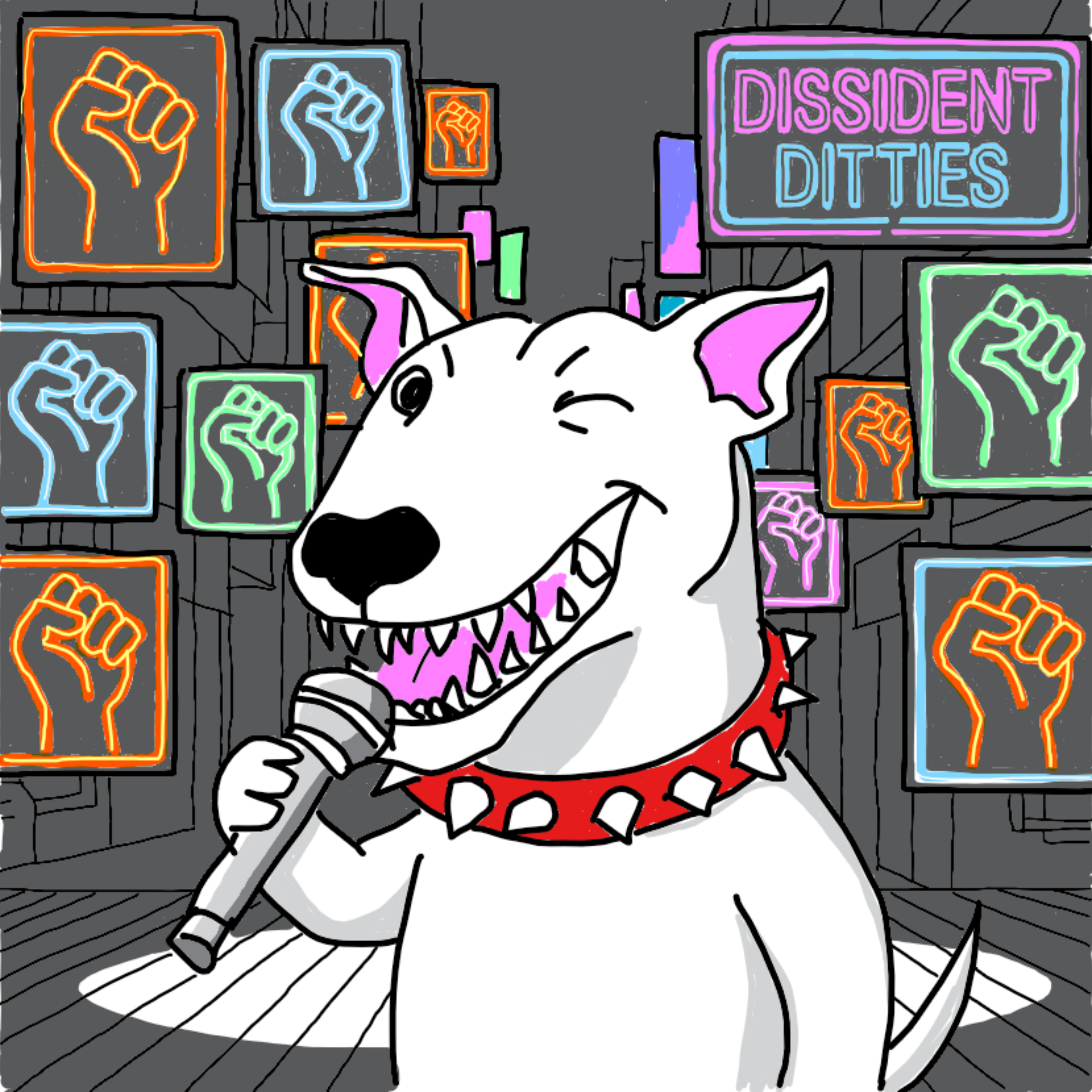
I’ll admit, in the beginning, I was confused about who the Australian hyperpop musician known as cUTEbRUTE was. The moniker blends feminine and masculine adjectives, and while I thought it was cool, I didn’t know what it meant. When I listened to the songs and heard this high-pitched voice, I thought “Oh! It’s a woman!”. It turns out that I was wrong, but hardly disappointed; after all, this was my kind of music, so what did I care. I’m not just a hyperpop fan, I became curious about vocaloid software, and downloaded lots of vocaloid music before I even knew what it was. It’s a sound that Mat Ward puts to good use.
Mat’s music is (to the best of my memory) the first hyperpop artist whose songs address the topics heard in this album, such as the artificial intelligence industry, consumerism, Iran, and more. Everything becomes clear when you listen to the songs he’s created under “Mat Ward”, his actual name. The electronic element is there, but stylistically, the songs are electronic pop punk. Being a huge fan of Atari Teenage Riot, I always considered electronic music as the perfect vehicle for subversive social and political commentary, but I wasn’t ready for the coded cuteness that is cUTEbRUTE. The sound doesn’t take away from the subject matter, instead, it makes it stand out.
I don’t think I’ve ever asked a musician this question, but as an electronic artist, did you start off with a traditional musical instrument (say, a sousaphone or mandolin), or did you jump right into the synths?
Yes, I usually come up with most of my hyperpop riffs on a sousaphone, in the bath. Nah! Just kidding. I did play something similar to a sousaphone as a kid - a cornet, similar to a trumpet. I was pretty good and played principal cornet - like a lead soloist - at competition level. But then I got cold feet before one competition and ran off and hid in McDonald's. That was the end of my cornet playing. So these days I usually start tunes by coming up with chord sequences or riffs on a synthesizer. But for most of this album I just listened to endless samples on the Splice app for inspiration, then came up with lead melodies that would form the catchy hook of each song, by whistling into my phone. From there, I wrote lyrics to fit each catchy whistled hook. Then I recorded me singing the lyrics. Then I started building each song around that, by designing weird sounds that hopefully haven't been heard before.
Musically, who were you inspired by and what caught your attention about these musicians?
Aggh, fuck. Well for more than a decade I've been writing a monthly protest music column that requires me to listen to more than 30 albums a month, of all genres. Spotify, the evil green platform, told me I listened to more than 500 genres in one year, or something ridiculous. So I'm more inspired to come up with something I haven't heard before. I specifically created this persona, cUTEbRUTE, because I wanted to blend cute vocals with brutish bass and drums. The thing was, when I started mixing and mastering the songs, I needed similar "reference tracks". Reference tracks are successful songs that sound roughly the same style as yours, so you can try to match your songs' sound to them. But I couldn't find any. Then someone told me about a website you can feed your songs into, for it to suggest similar-sounding tracks. Of course, it turned out there were loads of songs out there that sounded exactly like the supposedly unique genre I had in my head - a cute and chaotic version of hyperpop. So the singles I've already released from the album have already landed on playlists occupied by some of those great artists, such as 100 Gecs, Food House, underscores, and Petal Supply.
What difference, if any, is there between the recording process for trad musicians versus electronic musicians?
The main difference would be that you're moving air as a traditional musician. You're playing an instrument to make air vibrate, which is captured by a microphone, whether you're playing an acoustic guitar, a mandolin, or a sousaphone. Electronic music can all be recorded within the computer without any sounds having to be captured by a microphone. So you could make a purely electronic album just on a computer, or "in the box" as electronic musicians like to say. And you could endlessly edit it to fix your mistakes, whereas traditional musicians would usually have to practice the part and play it perfectly for the recording. In reality, most trad musicians these days are recorded into a computer and endlessly edited and tweaked later. And that is probably the most inadequate answer to that question you're likely to get from anyone! Argue in the comments!
Prior to your email to Neuerotica, I thought I already had some of your music in my library. No? Or am I imagining things?
Well, I released 11 albums under my real name of Mat Ward over the past 10 years, but they're all still available. As for cUTEbRUTE, Dissident Ditties is my debut album, but you may be confusing me with the homoerotic cartoonist Cute Brute. Or it could be because you actually reached out to me first when you came across my first cUTEbRUTE single when I shared it on Bluesky. That's still available too, though.
The first time I heard your music, I thought you were a woman because of the high pitched vocals and, of course, your name. Why the name, and why the high pitched vocals?
Well, the longer story is I'm a huge fan of future bass artist San Holo, who incorporates a lot of emotional lyrics into his songs. I usually write a lot of political, angry, protest music. But I wanted to try to write more personal, emotional songs like San Holo. A dear friend of mine was sexually abused as a kid, and had told me how her abuser would often enter her nightmares and so on. Thinking about that, I'd come up with the lyric "always see your face" which was inspired by San Holo's far more innocent love song "I Still See Your Face". I usually sing in a punk style. But my friend is into Japanese culture and preferred my old albums where I'd not sung in my own voice, but used a very time-consuming piece of Japanese software called Vocaloid. Users program Vocaloid to sing lyrics in a cute, robot voice. So for my friend's song, because it was inspired by her perspective, I recorded my usual, punk-sounding vocals but changed them using voice-changing software to sound more like the cute, female-sounding Vocaloid. That was the first song on the album. Then, because I'd always wanted to make music that contrasted cute vocals with brutish drums and bass, I just kept that sound for the whole persona of cUTEbRUTE. The name came to me after watching a comedy sketch by Vic Reeves and Bob Mortimer in which they advertise a dodgy-looking security dog called "Licky Kicky"with the marketing line: "He may look cute, but he's a brute!"
Are you a music first, lyrics later kind of artist, or is it the other way around for you?
Definitely always music first, and more than that, it has to be catchy. I'm lucky to be able to come up with endless riffs, but only a fraction are catchy enough to be made into a song, and then it's even harder to come up with lyrics to fit them, and then harder still to sing them in a way that doesn't sound ill-fitting or awkward.
How long does it typically take you to lay down and finish a track?
I have a timer on my music-making software, so I know it's usually at least 60 hours, sometimes 100. I manage to complete a song a month, and an album a year. I don't watch TV or go out much.
What’s your recording studio look like, in regards to what you require to compose a track?
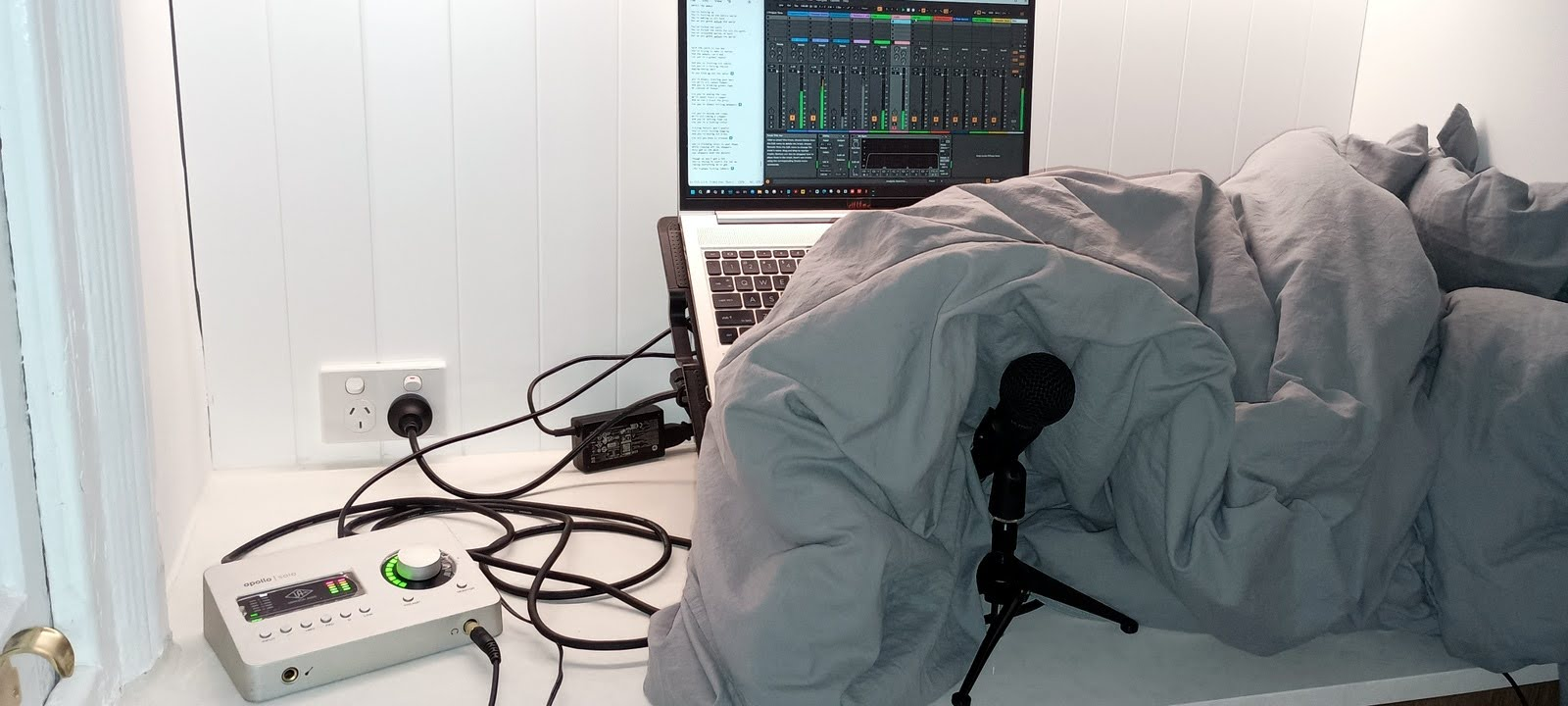
I do it all on a Windows laptop running Ableton, the most popular digital audio workstation software. But I record my vocals using a cheap Behringer copy of the world's most popular microphone, the Shure SM58. I simulate a professional vocal booth by putting a duvet around my microphone (see photo) to block out unwanted noise. I play software synthesizers using the free synth controllers I make - basically touchscreen versions of real keyboards.
Electronic pop music seems to be more prevalent now than at any other time in music history. Do you have any ideas why that might be?
Yep, the party drug MDMA and the revolution it caused back in 1988, when people started raving all night to repetitive electronic beats. For kids, Ableton became what guitars were for their parents.
If Love Songs Were Honest reminded me of a Threads conversation about problematic love songs, but your song addresses the disingenuous nature of the genre. What prompted you to write it?
Just the realisation that, with honourable exceptions, we're all on rails as a species trying to reproduce, and that the magic of love is an intoxicating state because the species has to reproduce to avoid extinction. Most people probably realise that far earlier than I did.
You cover a lot of social and political ground in your album, which leads me to believe that you’re one of those “radicals” the Terrorist In Chief and his Klan here in America incessantly babble on about. Yes? When did that journey begin for you?
My mum and dad are hard-left unionists, so that's where it probably began. But for the past 17 years I've been doing voluntary work for an activist newspaper, so a lot of it comes from that. I do that work more out of a desire to give people an alternative view of the world to that doled out by the corporate media, otherwise known as mainstream media. Having said that, a friend who I do a lot of walking and cycling with is a right-wing stock picker. I enjoy his company because he tells me things I'm not already thinking, and challenges my views, not that my views change much!
None of us are fortune tellers, but I assume you have your own view of where the current political landscape that has drastically changed the United States, and the world, is heading. We don’t want to return to the norm, which is how we got here in the first place, but does your music (or even music in general) help you get through the hell we’re all experiencing these days?
Yes, no one can predict the future, though a lot of people think they can. There's a great book about that called "Future Babble: Why Expert Predictions Are Next to Worthless, and You Can Do Better." I've been meaning to write a song about it. So yes, I have my suspicions that we're heading for climate catastrophe or nuclear oblivion, but you never know. And yes, making music is my main source of therapy for coping with that dread. I don't think I've gone insane, yet...
Stream cUTEbRUTE by following this link, and download the album free on Bandcamp
